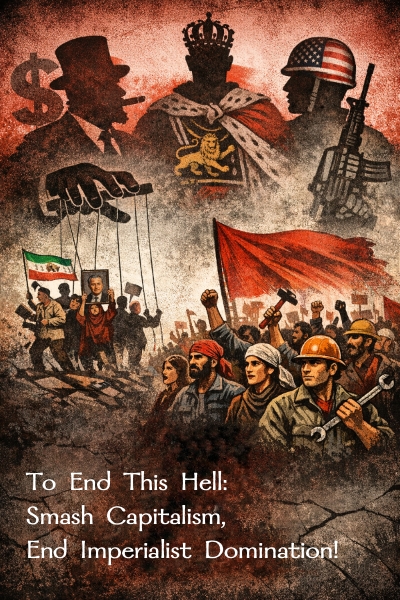
The Petite Bourgeoisie, the Working Class, and Social Movements in Iran
The Ontology of the Petite Bourgeoisie and its Class Tendency
The “petite bourgeoisie” is a bewildering social phenomenon. Within the diverse spectrum of social forces, and in comparison to the two primary classes of capitalist society—namely the bourgeoisie and the proletariat—which possess relatively stable economic positions and social identities, the petite bourgeoisie lacks both. Instead, it constantly fluctuates between these two poles. This, however, does not imply a lack of distinct class interests; on the contrary, what is deeply internalized and remains steadfastly inviolable within this specific social stratum is precisely its class interests.
In other words, depending on the conditions of the class struggle and the balance of power, the petite bourgeoisie may gravitate toward one of the two main classes. When pressured by the big bourgeoisie and pushed to the fringes of society, it revolts against the bourgeoisie. Conversely, when it finds opportunities for upward mobility within the capitalist framework, it becomes a staunch and fierce defender of the system’s core tenets, such as individualism, private property, profit, and the accumulation of wealth.
In principle, it must be remembered that from a material and historical standpoint, the petite bourgeoisie constitutes the embryonic form and the constitutive element of capitalist society. In fact, prior to the emergence of the bourgeoisie on the national stage, its seeds germinated as petite-bourgeois elements within medieval towns and burghs. Through a prolonged transitional period—traversing various forms of productive and commercial activity alongside the advancement of science and industry—the foundations of capitalist production (which, as Marx notes, crystallizes only through ‘factory production’) led to the establishment and hegemony of capitalist relations in society. Thus, the petite bourgeoisie is naturally a defender of the capitalist order and a herald of bourgeois ideology within society; the scope of its economic interests and socio-political outlook does not transcend the limits of the bourgeois horizon—even when its interests clash with those of the big bourgeoisie and it rises in rebellion against it.
Another hallmark of the petite bourgeoisie is its conservative approach to social issues and, more broadly, its reformist outlook and conduct—a trait directly rooted in its class nature. From a philosophical perspective, the petite-bourgeois worldview often operates within the framework of formal logic; that is, it generally perceives phenomena based on their ‘accidents’ (superficial appearances) rather than their ‘essence’ (internal logic and essential movement). Consequently, when faced with socio-economic crises and malfunctions, instead of addressing the root causes, it focuses on the peripheral, the marginal, and the symptoms. In this process, for instance, it often reduces structural deadlocks to a mere ‘crisis of management,’ or attributes autocracy and the violation of societal rights solely to the temperament of a cruel ruler or the idiosyncrasies of an individual dictator. In truth, the myopic horizon of the petite bourgeoisie precludes a profound understanding of the fundamental causes of various forms of oppression and social inequality. It harbors the illusion that a human-rights utopia can be achieved without a radical transformation of class relations and the dominant power structure. As Lenin observed, the petite bourgeoisie oscillates between ‘labor’ and ‘capital,’ perpetually seeking a phantom ‘third way’ that has no objective existence.
Now, in so far as the formation or emergence of the middle class is concerned, it must be noted that, generally speaking, any form of the capitalist system—advanced or peripheral; liberal or dictatorial—in adition to small economic enterprises within the sphere of production and commerce, inevitably fosters the formation of various bureaucratic and technocratic layers, and naturally vast sections of intellectuals and professionals, within its social metabolism. These groups constitute a significant portion of that ‘middle class’ which desires change, but not structural change; rather, they mainly think in terms of replacing economic and social management. These layers themselves, of course, have different strata, each exhibiting various levels of protest against and compromise with the status quo.
A look at the socio-political events in Iran over recent years—specifically the emergence of the slogan “Woman, Life, Freedom,” which many characterize as a “movement” and some even hail as a “revolution”—vividly illustrates this quintessential petite-bourgeois outlook and conduct.
This slogan, contrary to the perceptions of many activists and media outlets, was not the product of a coherent and conscious program. Rather, it was primarily representative of and derived from a spontaneous action; a slogan which, due to its interpretable nature, non-class perspective, and diversionary effects among the masses, was swiftly and actively embraced by international reactionary and reformist forces, dominating global headlines. Consequently, in international forums and the press, the rightful struggles of workers and the oppressed masses for their fundamental and long-standing slogans—namely Bread, Jobs, Housing, Freedom, and Independence—were marginalized, while issues such as the abolition of the mandatory hijab and, more broadly, the demand for liberal freedoms, were portrayed as the primary demands of the people.
From a class standpoint, this slogan—due to both its interpretability and its limited socio-political horizon—generally finds broad resonance among those sectors of society whose daily and permanent existence is not submerged in the vortex of poverty, economic incapacity, and extreme deprivation. These sectors essentially comprise the middle strata of society, or the petite bourgeoisie—commonly referred to today as the “middle class”—whose primary concerns and general demands fit well within the framework of this slogan.
At the same time, due to its reformist nature and its implications for the trajectory of social struggles (necessitating non-structural changes), and also because of the significantly higher organizational capacity of this social stratum—both in terms of material resources and institutional access, as well as their acceptance and visibility within international media and institutions—this slogan and the reformist demands embedded within it have had a much greater chance of dominating public opinion. Meanwhile, the voice of the workers and the lower classes of society, despite their vast numbers and their constant, tireless struggles, has been reduced in the international press to a marginal issue—or, in other words, “one issue among many.“
The Ontology of the Working Class and the Question of Class Consciousness
At this point, it is necessary to delve into both ontological and epistemological categories: the ontology of the working class and the category of its class consciousness. As is well known, in his discussion of classes, Marx speaks of concepts such as the “class in-itself” (Klasse an sich) and the “class for-itself” (Klasse für sich)—concepts directly linked to class consciousness. This implies that a class unaware of its historical and class interests remains confined within the shell of a “class in-itself”; only when it becomes conscious of its historical interests and acts to realize its will does it transform into a “class for-itself.” On this basis, as long as the working class has not attained class consciousness, it inevitably functions as a “class in-itself,” thinking and acting within the constraints of the dominant ideology. In other words, it perceives the world through the narrow lens of those forces that are conscious of their own interests. While it is true that certain elements and strata of the working class possess class consciousness, this by no means implies that the working class as a whole has attained it.
A fundamental and long-standing question that has consistently occupied the Iranian revolutionary movement, and remains before us today, is the absence of a unified working class equipped with its own revolutionary organization and program of action. But what has prevented the working class from attaining its own class organ and a revolutionary program? Why does the vast Iranian proletariat—despite appalling working and living conditions and thousands of strikes and protest actions in recent years—remain fragmented and devoid of an independent, nationwide revolutionary organization?
To answer this, it must be emphasized that the primary obstacle to the formation of a proletarian political alternative in Iran has been, and remains, the existence of a brutal and unrestrained dictatorship. One must note that this structural repression is not merely limited to state violence against labor protests; rather, it acts as a decisive barrier preventing the organic link between revolutionary intellectuals and the working class. Consequently, this severance obstructs the infusion of socialist consciousness into the labor movement and thwarts the objective necessity for the proletariat to organize within its own independent political organs.
Under conditions where the formation of any genuine and sustainable organization is denied to the working class, and the organic bond between this class and revolutionary intellectuals is rendered impossible, the working class remains fragmented, and its daily trade-unionist struggles fail to merge with socialist consciousness. Therefore, despite thousands of labor strikes and protests across the country in recent years, this inherently revolutionary and epoch-making class has, unfortunately, been unable to appear on the Iranian political stage as a unified, organized force with a coherent and revolutionary platform. As a result, it has yet to seize the helm of the democratic and mass struggles of society or to delineate a clear horizon for the people.
Some on the Left, clinging to the theory of “spontaneity,” imagine that the working class achieves socialist consciousness through the course of trade union struggles. Others, falling into the trap of “Workerism” (an idealized view of workers), mistakenly believe that material belonging to the wage-earning class inherently equates to radicalism. In reality, a large portion of wage-earners, in the absence of class consciousness, breathe within the sphere of petite-bourgeois thought. Without class consciousness and independent organization, the working class not only fails to enter the realm of revolutionary struggle but can also be lured by supra-class slogans under the influence of petite-bourgeois ideologies, leading the revolution astray.
Another analytical weakness of “Leftist” groups and organizations is the neglect of the petite bourgeoisie and the failure to define its position in the trajectory of social transformations in Iranian society. That is to say, although the petite bourgeoisie—or the middle strata—is recognized as a “social entity,” it has not found its true place in the formal analyses of many Leftist currents. Many on the Left bypass the complexity of the petite bourgeoisie and its role in the ongoing class struggle by oversimplifying the social structure, claiming that since the majority of society are wage-earners, the vast majority of the population are therefore the “working class.” Such an outlook, however, bears no resemblance to a Marxist understanding and analysis of the concept of the working class.
Unfortunately, even among those political currents that acknowledge the role and significance of the petite bourgeoisie in their analyses, this social stratum—this intermediate layer—is often portrayed in a faint or non-objective manner regarding recent developments in Iran. It is as if the petite bourgeoisie exists without possessing any objective manifestation or social impact! Does the social existence of this stratum not have material and objective consequences for society? And if it does, what is its material and objective manifestation? Yet, this segment of the Left offers no significant insight regarding this stratum, its voice, or its role in socio-politic dynamics. However, through a Marxist lens—and with an understanding of the composition and scope of inherent petty-bourgeois concerns and demands—one can clearly discern and acknowledge the alignment of the slogan “Woman, Life, Freedom” with the aspirations of this social class. Consequently, one can identify and accurately characterize its material and social foundations within the fabric of society, rather than either constructing a ‘socialist’ theoretical justification for it or, conversely, dismissing it as purely fabricated and externally imposed. In fact, identifying this material basis and conducting an analytical inquiry into it is essential—not for its endorsement, but for adopting a proletarian stance towards it.
The Digression of the Left in the Ebb of the Communist Movement
Following the collapse of the Soviet Union and in light of the setbacks faced by twentieth-century attempts to build socialism, a new wave of modern revisionist theories emerged, rapidly proliferating across continents. The proponents of these theories included not only a new generation of theorists but also encompassed several formerly Marxist or radical intellectuals who had since revised their previous views and commitments (e.g., Régis Debray or Antonio Negri).
This new shift, while not entirely unprecedented—having been articulated earlier in marginal forms—has now emerged as a dominant intellectual current within “the Left,” effectively neutralizing or, at the very least, marginalizing the intellectual and social authority of twentieth-century Marxism. This transition is generally predicated on the critique that “orthodox Marxism and its core analytical foundations—namely historical materialism and class struggle—constitute, respectively, linear and reductionist approaches to complex and multi-layered social realities.” Based on this reassessment, numerous theories have emerged, positioning themselves as evolved versions of Marxism or as alternatives to its so-called “linear” and “reductionist” framework within contemporary socio-political discourse. One such theory is “Intersectionality” (the interlocking of layers of oppression), which I shall briefly address here, particularly due to its prevailing presence and influence in promoting the slogan “Woman, Life, Freedom.”
It must be asserted that the theory of Intersectionality is not an evolution of Marxist thought, but rather an epistemological regression and a product of the rupture from historical materialism. By presenting various forms of oppression (gender-based, sexual, ethnic, etc.) as equivalent to class antagonism, this approach effectively reduces the ‘primary contradiction’ between labor and capital to merely one of many parallel components. By stripping away the determining role of the economic base, social oppressions are transformed into abstract phenomena severed from the relations of production. Yet, from the perspective of revolutionary Marxism, all these forms of oppression are historical instruments for the reproduction of class society and the exploitation of labor—their eradication is achievable only through the path of class struggle.
This distorted outlook, by substituting ‘identity politics’ for ‘class consciousness,’ sterilizes revolutionary action and fragments the ranks of the proletariat into pluralistic, disjointed sections. This is precisely where petite-bourgeois intellectuals—by importing academic theories from an era of decline and the retreat of the communist movement—transform the Left into the foot soldiers of reformist demands within the framework of the dominant order. Consequently, instead of forging a fighting solidarity toward the overthrow of the capitalist system, the workers and the oppressed masses are steered toward the pursuit of minimal, specific, and sectional demands within the existing order, failing to target the root cause of all societal maladies and oppressions: the unjust and inhumane capitalist order.
Ultimately, the infiltration of this thought into recent events in Iran has culminated in a form of “identity populism,” paving the way for the hegemony of petite-bourgeois ideology. That segment of the Left suffering from this disorientation—by defending classless slogans that lack clear demarcations—has effectively failed to fulfill its vanguard role, instead succumbing to tailism (or as Lenin termed it, Khvostism) toward spontaneous movements. Rather than exposing the class roots of oppression and offering an independent proletarian alternative, this current has occupied itself with the theoretical justification of middle-strata demands. In doing so, it consigns the historical opportunity to link democratic struggles with the strategy of socialist revolution to oblivion.
On the other hand, there remains a section of the Left that, while not ensnared by the tailism of spontaneous movements and possessing a historical clear-sightedness regarding the petite bourgeoisie, offers only limited and incomplete analyses of recent social movements in Iran. While they recognize the petite bourgeoisie as a social reality, they largely overlook its practical and ideological impact on the trajectory of movements and the revolutionary path in the current conjuncture.
Conclusion:
The reality is that the slogan ‘Woman, Life, Freedom’—precisely due to its supra-class nature and its interpretive malleability—served as the ideal instrument for the petite bourgeoisie to vent its rage without targeting the capitalist system. Under such circumstances, the duty of the Left was neither to ‘justify’ this ambiguity nor to “sidestep” the slogan as a mere fabrication of international reaction; rather, its task was, and is, to expose its class character and provide a revolutionary proletarian alternative from within the heart of these struggles. This is a task that the majority of the Left failed to fulfill, and continues to neglect.
And now.
As is widely recognized, Iranian society has lived in a state of explosive volatility for years, such that at any moment and in every corner, a sudden eruption of popular rage is imminent. Time and again, triggered by one of many deep-seated grievances or countless unhealed wounds, the people’s suppressed anger overflows. Given the common root and cause of all these, such outbursts often incite and mobilize other sectors of society to join in.{*}
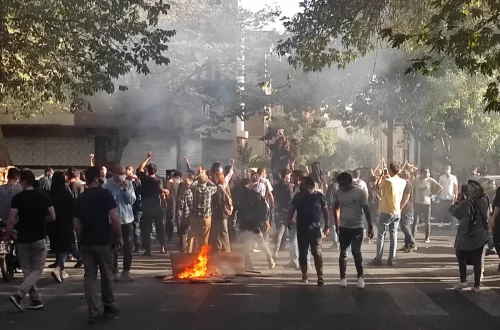
The embers beneath the surface of Iran’s turbulent society flared up once more a few days ago. We are now witnessing yet another chapter of this national-scale social rebellion; the grievances of one sector have transformed into nationwide protests, which—as usual—have been met with shameless, bloody repression. Once again, we are confronted with that age-old and central task: to provide a class-based analysis and a revolutionary alternative—a program born from and responding to objective realities.
One of the gravest and most painful consequences of the absence of a revolutionary program and alternative before society is that the rebellious and risen masses—much like in the 1979 Revolution—will move toward the overthrow of the ruling regime without targeting the underlying socio-economic order. They risk doing so without a clear and precise vision of an alternative system—one capable of uprooting the origins of all existing societal malaises and establishing relations that encompass the true interests of the masses. The devastating impact of this absent element—namely, the lack of a revolutionary program and alternative—can currently be observed within the surging tide of the mass uprising in streets across the entire country.
But what constitutes a revolutionary program? The primary and most fundamental objective of any revolution is the seizure of political power. Without attaining this power, even the most sublime ideas will fail to manifest. This was precisely the case following the 1979 Revolution, where not a single one of the rightful demands of the oppressed masses was realized; instead, everything achieved through blood and toil was annihilated in the most treacherous and brutal fashion.
The question, therefore, is how to seize political power when confronted by a repressive force armed to the teeth. In the words of Comrade Masoud Ahmadzadeh:
“The seizure of political power is an indisputable goal, and its necessity is a universal truth. The real question is: what is the decisive factor in the act of seizing power? If, instead of addressing this need and determining the specific path of action and the primary mode of struggle, we merely state that ‘the goal is to seize power rather than to destroy the army’ or that ‘we must intervene comprehensively at all levels and employ all forms of struggle,’ we are merely engaging in platitudes. Behind such generalizations lie political incompetence, a lack of courage, and political ignorance.” (ARMED STRUGGLE; BOTH A STRATEGY AND A TACTIC)
The Achilles’ heel of the Iranian revolution lies precisely at this juncture: the inability to provide a concrete and practical response to the question of seizing political power under the conditions of naked dictatorship and state violence. The historical experience of class struggles in dependent countries with autocratic political structures—such as Iran—demonstrates that conventional forms of political activity, ranging from street protests and civil disobedience to reformist pressures and legal advocacy, including the litigation movement (Jonbesheh Dadkhahi), are not only incapable of advancing a revolutionary transition when facing a centralized apparatus of repression, but often wither away within the corridors of legal institutions or are violently crushed.
Historical experience further reveals that in societies with such political structures, even the independent organization of the masses in fragmented and decentralized forms quickly becomes ineffective or leads to exhaustion and defeat if not bolstered by the robust support of armed power. Therefore, the necessity of organized revolutionary violence is not a theoretical choice, but an objective and historical response to the socio-political conditions and the nature of the autocratic state in Iran; a response that can only be realized through the formation of a cohesive organization capable of both armed defense and offensive action.
It must be noted that bourgeois states in their autocratic and neo-colonial forms are not merely administrative or legal entities; they are, first and foremost, organs for exercising class violence in defense of the prevailing relations—namely, dependent capitalism and the continuity of imperialist domination. Consequently, any revolutionary program of action that takes the question of political power seriously must inevitably transcend the level of fragmented and predominantly defensive forms of struggle. It must contemplate the necessity of creating organized instruments of revolutionary assault—tools capable not only of shifting the balance of forces in favor of the subaltern classes but also, at the moment of revolutionary rupture, facilitating the smashing of the state apparatus of repression and its replacement with a new power emerging from the masses.
In the face of a violent and unbridled dictatorship, such as the imperialist-dependent regime of the Islamic Republic that has ruled our people for over four decades, victory cannot be achieved through no means other than a nationwide mass politico-military organization—that is, a People’s Army. However, such a mass organization can neither be constructed through legal means and overt activity, nor can it emerge instantaneously. The dialectic of reality itself—the rule of dictatorship—mandates that initially through underground work and via small, clandestine armed cells the groundwork for a nationwide armed organization be laid. This must be a political-armed organization that, by relying on firepower against the enemy’s repressive forces, possesses not only the possibility of survival but also the capacity for offensive action, thereby preventing the enemy from having a free hand in suppressing the masses. This armed organization, through the growth and expansion of its sphere of action and ultimately by arming the masses, shall evolve into the aforementioned nationwide mass politico-military organization—a People’s Army that, under communist leadership, battles the enemy, smashes its reactionary and anti-people army, puts an end to the dictatorship, and by seizing political power, realizes the rightful will and demands of society’s oppressed masses.
At this juncture, all Iranian revolutionaries—and first and foremost the communists—stand before this specific and decisive task.
{*} For a detailed description of the class composition of popular dissent in recent years in Iran, see A. Behrang, “A Look at Iran’s Recent Upsurge,” Panta Rhei, October 2, 2022, https://eng.abehrang.com/2022/10/02/a-look-at-irans-recent-upsurge/.


3 Comments
Henri
This writing is divided into four main parts. The first part deals with the historical development of the petite bourgeoisie and its contradictory, wavering characteristics as a stratum as well as the inherent reformist role it plays in social struggles.
The second part explains the revolutionary necessity for class consciousness among the working class and points to the dictatorship in Iran which prevents its attainment. Instead, false consciousness prevails in the Iranian people’s unorganized uprisings where a dialectical analysis is given as to why the Left’s leadership is nowhere to be found.
The third part consists of a Marxist-Leninist analysis and critique of the so called Left of today. The author gives the reader a vivid depiction of the myriad of reactionary views that dominate and suffocate the leftist landscape of our times.
The conclusion details what is to be done in order for the Iranian masses to achieve class consciousness and thereby have the capacity to direct their uprisings towards revolution. The author details as well the Left’s necessary role to achieve this. Despite the extremely dire situation the writer describes, the article nonetheless ends on a hopeful note. The hope is that a day will come when the people will free themselves from capitalism’s tyranny in order to achieve self-determination.
Rachel
I have read the article, however, I have comprised the following critique which I believe shines a light on what it lacks:
You make a series of general statements regarding the petite bourgeoisie that any Marxist could agree with.
However, you do not specify exactly whom you consider to be the petty bourgeoisie in Iranian society, making it difficult to agree or disagree with them on the subject of the ‘petty bourgeoisie’ in Iran. Granted, in one instance, you define ‘those segments of society whose daily and permanent lives are not drowned in a whirlpool of poverty, economic disability, and extreme deprivation’ as the ‘middle strata of society or the petty bourgeoisie.’ Based on this, the reader understands that, in your view, only the semi-affluent strata in Iran—without specifying their actual occupations—constitute the petty bourgeoisie.
This raises the question: if, according to your definition, groups like poor farmers, nurses, or teachers—who are drowned in a whirlpool of poverty, economic disability, and extreme deprivation, and who have publicly voiced their hardships in numerous gatherings in recent years—are not petty bourgeois, then to which stratum or class do they belong?
After outlining the views and behavior of the petty bourgeoisie in general, your article claims that the ‘Woman, Life, Freedom’ slogan in Iran ‘clearly demonstrates this authentic petty-bourgeois outlook and behavior’ and suggests that the emergence of this slogan was driven by the Iranian petty bourgeoisie in socio-political events. Yet, you provide not a single objective fact to support this judgment or allow the reader to agree with their view.
In reality, all broadcasted videos of the people’s struggles in 2022 show that the slogan ‘Woman, Life, Freedom’ was not being chanted in them. While that uprising included not only workers—mainly unemployed workers—but also individuals from the semi-affluent or even wealthy classes, such as doctors and those with high-income jobs. A simple look at the list of martyrs from that movement proves this fact.
Therefore, for a live and productive discussion about this article, specific objective facts must be presented.
Furthermore, there are many objective facts proving that it was the international media and institutions—or more accurately, the massive imperialist propaganda machine—that imposed this Ocalan-created slogan onto the movement of the Iranian masses (who are deprived of liberty and even individual freedoms, hungry, and homeless). Today, this slogan is repeated not only by known reactionaries and their affiliates but also by a segment of intellectuals abroad. In fact, despite all the propaganda carried out to popularize that meaningless slogan, the ongoing movement shows that ‘Woman, Life, Freedom’ was never the slogan of the Iranian people; because in this movement, there is no evidence of that meaningless slogan being chanted.
A. Behrang
Thanks for your respons. To answer you, I’ll break it down as follows:
1. On the “definition of the petty bourgeoisie” and the demand for a job list.
I believe the first critique raised by you stems from a methodological misunderstanding. You expect the petty bourgeoisie in Iran to be defined as a fixed list of occupations (teacher, nurse, farmer, clerk, engineer, etc.). In the Marxist tradition, however, the petty bourgeoisie is not a static occupational category but a socio-economic position within the metabolism of capital, defined by its specific relation to production, power, consciousness, and ideology—not merely by income or job title.
My text explicitly explains that capitalism—regardless of whether it is liberal or dictatorial—inevitably reproduces layers such as bureaucrats, technocrats, specialists, intellectuals, and managers in addition to direct producers or trades. This is precisely the definition of middle layers and their ideological role given by Marx, Engels, Lenin. Demanding that the author specify “which jobs are petty bourgeois and which are not” is not only unscientific but also reductionist, even absurd.
2. On poor farmers, teachers, and nurses.
Here you commit two simultaneous errors.
First, you assume the petty bourgeoisie is a homogeneous, static layer with a uniform economic status. In contrast, my text clearly states that this layer has internal divisions, gradations, and tendencies, ranging from accommodating to oppositional, from conservative to radical.
Second, you mechanically equate material poverty with class position and political consciousness. I explicitly emphasize the opposite: economic hardship does not guarantee class consciousness, and in the absence of revolutionary organization and theory, it may even reproduce bourgeois ideology. A salaried teacher or nurse may be under severe economic pressure yet continue to inhabit a petty-bourgeois or even bourgeois ideological horizon—entirely consistent with Lenin’s analysis of unproductive labor and spontaneous consciousness.
3. On the relationship between the slogan “Woman, Life, Freedom” and the petty bourgeoisie.
You claim that I attributed this slogan to the petty bourgeoisie without “empirical evidence.” This criticism stems from a positivist understanding of politics and ideology (meaning an approach that treats politics as a collection of immediately visible facts and events, rather than as a process shaped by ideology, class relations, and social consciousness). I never asserted that only petty bourgeois individuals chanted this slogan, or that anyone who did so is necessarily petty bourgeois. My argument concerns the ideological origin and class content of the slogan, not a statistical count of demonstrators in videos.
A slogan that is non-class-based, open to interpretation, and devoid of a clear horizon of political power or change in the relations of production, in itself demonstrates the hegemony of a petty-bourgeois and idealist logic—even if chanted by an unemployed worker, a student, or a university professor. You fail to grasp this fundamental distinction between social actor and ideological content.
4. On “absence of the slogan in videos” and empirical evidence.
The argument that “because the slogan is not heard in some videos, it was not a slogan of the Iranian people” is extremely weak and theoretically naive. First, political discourse does not form solely in the streets or in momentary chants; it develops through analyses, statements, podcasts, media, organizational positions, and the reproduction of discourse. Second, in reality, from 2022 onward, a wide range of political forces—from the right to parts of the left—endorsed, theorized, and even labeled this slogan as a “movement” or “revolution.” Denying this fact is denying an objective socio-political phenomenon.
5. On the role of imperialist media.
Even though imperialist media played a decisive role in amplifying the slogan, this does not refute my analysis; it confirms it. The central question remains: why and how did a segment of society—both inside and outside the country—be prepared to adopt and reproduce such a slogan? Media cannot impose a slogan on a movement from a vacuum unless a pre-existing mental, ideological, and class receptivity exists. This receptivity reflects precisely the state of the mind of the masses, the decline of revolutionary Marxist hegemony and the dominance of idealist, identity-based, and reformist perspectives that I’ve highlighted.
Ultimately, your critique does not point to real weaknesses in my text but to your own inability to understand a non-essentialist class analysis. You assume that the masses are inherently revolutionary, that poverty automatically produces radicalism, and that street slogans are the ultimate measure of political truth. In contrast, my argument follows the classical Marxist tradition: Without revolutionary theory, without revolutionary leadership, and without organization, neither the working class nor any other social layer is immune to deviation, illusion, or bourgeois hegemony.This is not a minor misunderstanding but a fundamental divergence in political perspective.
Finnally, in response to your claim: “the ongoing movement shows that ‘Woman, Life, Freedom’ was never the slogan of the Iranian people,” I’ll remind you of the following facts attainable through a simple google search:
Numerous reports and statements confirm that broad segments of the nursing and teaching communities in Iran supported the “Woman, Life, Freedom” movement and its slogan.
Evidence of this support is documented in the following areas:
Official Statements by The Coordinating Council of Iranian Teachers’ Trade Associations explicitly stated in its proclamations that the “Woman, Life, Freedom” movement, by reclaiming women’s agency, has paved the way for the liberation of all marginalized groups, including teachers and retirees. Similarly, teachers’ unions in various cities, such as Fars and Nourabad Mamasani, declared their support for the nationwide protests and the people’s demands.
Various professional groups, including doctors, nurses, and teachers, demonstrated their solidarity with protesters during the 2022 uprising.
In the protests held by retirees and teachers during 2022 and 2023, alongside livelihood-related slogans such as ‘Our salaries are in Rials, but our expenses are in Dollars,’ slogans were also chanted in support of the release of political prisoners and protesters who had been arrested under the banner of “Woman, Life, Freedom.”
In December 2022, numerous shopkeepers and bazaar merchants in various cities—who represent the middle and sometimes lower strata of society—went on strike in response to calls associated with the ‘Woman, Life, Freedom’ movement. This demonstrates the practical alignment of these groups with the political identity of the movement.
Teachers and other labour groups emphasized in their statements that these protests are the voice of a people seeking dignity and livelihood, accepting “Woman, Life, Freedom” as a central slogan for advocacy and change in Iran.
While some analyses may criticize the origins or the promotion of this slogan, objective facts indicate the active joining and support of these strata for the movement identified by this slogan.
Various reports and documents indicate that in addition to the urban middle class, other strata such as poor farmers, industrial workers, and the “middle-class poor” also supported the “Woman, Life, Freedom” movement through specific actions.
Key documented evidence includes:
Joint Charters and Statements: In February 2023, a historical document known as the “Charter of Minimum Demands of 20 Independent Trade Unions and Civic Organizations” was published. This charter, which included the Union of Free Workers of Iran, the Syndicate of Workers of Tehran and Suburbs Bus Company, and the Coordinating Council of Iranian Teachers’ Trade Associations, explicitly endorsed the “Woman, Life, Freedom” movement as a platform to end poverty, discrimination, and exploitation.
Solidarity from the Agricultural Sector: While farmers in regions like Isfahan and Khuzestan primarily protest over water rights, during the 2022-2023 uprisings, groups of farmers issued statements or joined local rallies where the “Woman, Life, Freedom” slogan was central. They linked their “right to water and livelihood” to the broader “right to life” and “freedom” advocated by the movement.
Action in Marginalized Provinces: In provinces like Sistan and Baluchestan and Kurdistan, which have high populations of impoverished workers and farmers, the slogan was chanted weekly. The Zahedan Friday protests (led by the community in one of Iran’s poorest regions) became a consistent site where the slogan was used to demand both ethnic/religious rights and economic justice.
The “Middle-Class Poor” Factor: Sociologists point to the participation of the “middle-class poor”—individuals with high cultural capital (like educated youth from farming families) but low income—who acted as a bridge, bringing the slogan into the heart of marginalized neighborhoods and rural outskirts through local “Neighborhood Committees” (Showra-ye Mahal).
Labor Unions’ Support: Beyond the teachers and nurses, the Haft Tappeh Cane Sugar Workers’ Syndicate issued multiple communiqués supporting the protests, stating that the liberation of women is inseparable from the liberation of the working class from poverty and oppression.
In summary, objective facts—such as the Charter of Minimum Demands and the weekly protests in impoverished provinces—demonstrate that this slogan transcended class boundaries and was adopted by the lower strata as a cry against systemic deprivation.
The claim that the slogan “Woman, Life, Freedom” was not used by the people in field protests and was merely a product of foreign media propaganda contradicts a vast amount of objective evidence, documented videos, and eyewitness reports from the 2022 uprising. This slogan resonated not only in Tehran but also in remote towns, universities, and working-class environments.
Here are specific, documented examples of gatherings where the people directly chanted this slogan:
Initial Gatherings in Kurdistan and Sanandaj: The slogan was first chanted by women and mourners at the Aichi Cemetery in Saqqez during the funeral of Mahsa (Jina) Amini on September 17, 2022. It immediately spread to Sanandaj and other cities across Kurdistan.
Universities Across the Country: Major universities, including University of Tehran, Sharif University of Technology, Allameh Tabataba’i, Shahid Beheshti, and Alzahra University, were primary hubs for this slogan. Numerous videos from the University of Tehran on various dates (including October and December 2022) show students chanting it collectively.
Neighborhood-Based Protests in Tehran: In various Tehran neighborhoods such as Pounak, Ekbatan, Sattarkhan, and Shariati, there is documented footage of street gatherings where people sang or chanted this slogan in unison. It was even heard in more working-class southern districts like Nazi Abad.
Major and Small Cities:
Arak: On October 22, 2022, documented videos showed residents of Arak chanting “Woman, Life, Freedom” during large street protests.
Rasht and Anzali: Gilan province was a major center where even the Gilaki version of the slogan (“Zan, Zivish, Azayi”) was heard in the streets.
Take a look at the link below (it is in Farsi, but a google translation should suffice).
https://www.radiozamaneh.com/846394/
Isfahan and Mashhad: Multiple videos from main thoroughfares, such as Chaharbagh in Isfahan and Vakilabad Boulevard in Mashhad, recorded crowds shouting this slogan.
Schools: In October 2022, numerous reports and videos were released showing schoolgirls in Tehran, Karaj, and Shiraz chanting the slogan in schoolyards or while leaving school premises.
While some may argue that international media played a role in highlighting this slogan, the raw mobile phone footage recorded by citizens at the scene of the protests (often shared via grassroots platforms like 1500tasvir) proves that “Woman, Life, Freedom” became a central pillar of the protesters’ identity on the ground.
1500tasvir is an anonymous social media-based activist collective that played a crucial role in documenting and sharing footage and information about the Mahsa Amini protests and other anti-government demonstrations in Iran.
Feminists 4 Jina: Another grassroots collective that supports the “Woman, Life, Freedom” movement.
From Iran: An anonymous collective that contributes to the documentation and dissemination of protest news and media.
Be Iran’s Voice: A UK-based grassroots collective dedicated to amplifying the voices of protesters in Iran.
NationBuilder: While a general advocacy software, it is used by various grassroots movements and non-profits to build communities, organize campaigns, and fundraise, offering tools for independent action.
Action Network: A digital toolset for progressive organizing, allowing activists to create petitions, manage email lists, and coordinate events.
General Social Media (TikTok, Twitter/X, Instagram): These platforms are used by activists globally to bypass state censorship, share information, and garner international attention, often using specific hashtags and campaigns like #MahsaAmini or #StopExecutionsInIran. Groups like 1500tasvir operate primarily on these platforms (Twitter, Instagram, Telegram).
Videos of Street and Neighborhood Gatherings: “Woman, Life, Freedom” chant in Tehran’s Ferdows Boulevard coinciding with the 40th-day memorial of Mahsa Amini in October 2022.