Social Psychology of the Masses
A Glimpse into the New Rites of Mourning among Bereaved Families In Iran
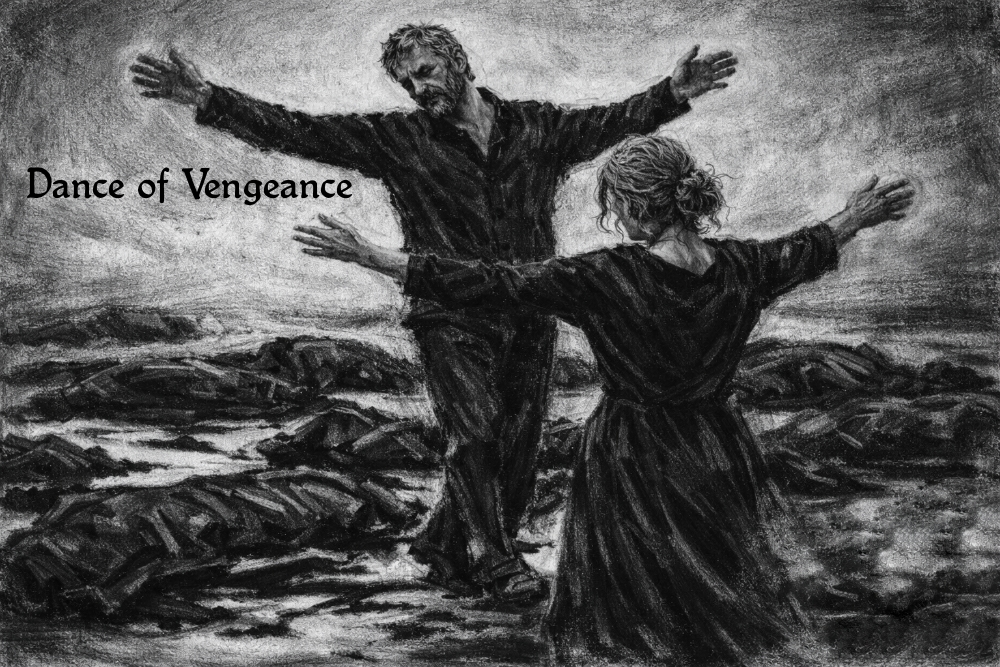
The significant shift in the forms of mass mourning in Iran today—where dances of vengeance and battle hymns have supplanted wailing and lamentation—is a majestic manifestation of the struggle of a people who seemingly have nothing left to lose. Thus, they no longer succumb to weeping over the parting and loss of their loved ones; instead, they sharpen the blade of vengeance to the rhythm of their unquenchable rage.
The sheer scale of gallantry and self-sacrifice displayed by the broad masses to escape the horrific conditions forged by the current regime is truly awe-inspiring and beyond praise. The blood-drenched body of the 2025 spontaneous uprising, along with every revolt of the past decade, stands as a living embodiment of the recurring revolutionary situations rising before our eyes. Yet, each time, despite the immense sparks of hope and the proud tremors they send through society, they are struck down to writhe in their own blood. And yet, there is neither cowering nor submission; instead, the lightning-bolt of dignity still shines from the blood-stained brows of our people; the same people who, in the February 1979 revolution, struck the crown from the head of the ‘King of Kings,’ battle once more to cast the diadem from the heads of the cloaked tyrants.
In spite of all this, the surge of various layers of a people in revolt—revolting against suffering, oppression, and corruption; revolting against poverty, deprivation, and tyranny—compels us to recognize that the shift in the psychology of the masses, and specifically the steadfast forms of mourning practiced by the bereaved, is not so much a definitive philosophical break from religion as it is a manifestation of the defiant spirit of the masses and their revolt against the official ideology of the reactionary and criminal Islamic Republic regime.
This naked spirit of defiance at the gravesites of the fallen also reveals a diverse class spectrum; where the bridal trays (Khancheh( of mourning—despite the unspeakable sorrow they cradle— serve as a stark mirror to the class contradictions of a society on the brink of explosion. This is vividly evident in the scenes surfacing on social media. Yet, this heterogeneous class composition is not a contradiction, but rather the defining characteristic of the democratic revolution in our society. Thus, these scenes—while serving as a painful reminder of the shadow cast by class relations even in the province of death—simultaneously manifest a form of unwritten democratic solidarity against a regime that has stripped the right to life from every member of society.
In such specific historical conditions, although the dreams and demands of the “affluent” or “semi-affluent” strata pertain to a better socio-economic position and civil liberties and those of the dispossessed to bread and survival, all these social layers are in practice being forged together under the regime’s crushing blows. In every spontaneous uprising of the past decade, we have witnessed, to varying degrees, the rebellion of both the subaltern and middle layers of society; at times “the struggle for daily bread” and the detriment of “unemployment,” at others “the longing for happiness and freedom,” here the concerns of the “people of the abyss” to stay alive, and there the yearning for a “normal life” have incited the pressured and deprived segments of society to rise against a common enemy. This is because the parasitic capitalists and the regime that sustains them have not only expropriated the surplus value of the workers’ labor but has also stripped the very possibility of existence from all strata under its dominion.
Thus, the “Dances of Vengeance” and the “Shriek of Rage” from various social strata converge at a single point: the total negation of the status quo. While the author does not align with the class horizons of the middle layers, he honors the radiance of this lightning bolt of pride in the face of anyone who stands against injustice and tyranny. For this class composition itself is the definitive sign of the ultimate decay of a regime that has set fire to the life and livelihood of the vast majority of society.
Indeed, in the face of a loathsome and despotic regime that for forty-seven grueling years has not only decimated the people’s livelihoods but—by subjugating the deepest layers of their private lives—has even stripped them of the freedom to express primal human emotions such as love, joy, and vitality, the masses have turned to the “inversion of symbols” or what is known in mysticism as “Sublime Blasphemy” (Kofre Matin). To preserve the survival of their soul and spirit, while simultaneously venting their loathing for the regime, they mock the lords of tyranny, baring their teeth in a snarl of rage through the mask of their bitter laughter. It is patently clear that within this framework, dancing upon the graves of loved ones who fell in the struggle against repressive forces is a political tool; it is both a response to the enemy and an expression of the people’s resolve to shatter the chains of bondage and servitude.
Consequently, characterizing this behavioral shift as a “cultural renaissance” or a departure from religious convictions is unrealistic—a product of analytical haste. A crucial distinction must be drawn between the desire for political secularism—the rejection of clerical involvement in governance—and the repudiation of personal faith in God and religion. What we witness today in the streets and at the gravesides of those fallen in the recent spontaneous uprising is a rebellion against the ruling regime and its “enforced form of religion”. While the masses voice their profound loathing for the state by rejecting official mourning rituals, this does not necessarily signify an abandonment of concepts such as God, religious belief, or spirituality within the private sanctuary of their lives.
A Marxist analysis reminds us that to comprehend why the masses dance upon the graves of their loved ones, we must look beyond the surface of events and the mere shell of human behavior. Instead, we must discern how, and to what extent, their very “life and survival” and “soul and psyche” have been so subjugated and trampled upon that they now erupt and explode like a volcano of hatred.
The new and noble ritual of people’s mourning today is a symbol of the iron will and firm resolve of the desperate masses who fight to topple the depraved ruling regime. At the same time, it is the living reflection of a massive conflagration—an accumulated fury whose night-shattering flames flare up from every direction. These are the fires of a people pushed to the brink; rebellious souls who, in their battle against tyrants, now stand upon the graves of their fallen loved ones with dances of vengeance and shouts of incandescent rage:
We stamp the seal of servitude upon the Moon and the Sun;
We mark the very heavens as if sealing a decree
…
As wine-stained, seasoned rebels and burners of the holy cloak,
With a single toss of our robe, we shall topple the foundation of withered piety.
A. Behrang
February 24, 2026


One Comment
Rachel
Through tears of rage the author has borne witness to the tragedy unfolding yet again for the desperate and furious people of Iran.
One can almost sense the echoes of their pained cries against the cruel injustices hailed upon them by their sadistic ruling captors. Through an astute Marxist analysis, the author differentiates between the rejection of religious customs dictated through terror on the people and their own personal religious beliefs.
And with the love for humanity that Marxism upholds, the author portrays every grieving family member as the heroic victims they are no matter what oppressed layers of society they belong to. The immense calamity has been brought upon all Iranian people just as their colossal sacrifice.