
A few words on Iran
Forty-six years after the imperialist powers—the United States, Germany, France, and the United Kingdom—decided at the Guadeloupe Conference to reorganize their domination of Iran through the political elevation of Khomeini’s clerical-bourgeois bloc, the Islamic Republic stands fully exposed as a specific form of imperialist rule: a dependent, reactionary state apparatus designed to secure imperialist interests through indirect domination. As we now know, these powers had arranged and facilitated Khomeini’s clique’s rise to power on three main conditions: (a) the preservation of the military structure; (b) the suppression of communists; and (c) the uninterrupted flow of oil—all of which the new lackey regime, that is, the Islamic Republic conceived in Guadeloupe, loyally fulfilled.
Beyond provoking tensions with the Iraqi regime under Saddam Hussein—tensions that culminated in a prolonged and devastating war between the two countries, a war that Khomeini referred to as a “blessing,” and which indeed proved so for the new regime insofar as it suppressed every demand of the revolutionary masses of Iran in the name of national defense—the war led to immense death and destruction. Its aftermath required large-scale reconstruction, binding Iran to imperialist capital through massive loans from the IMF and the World Bank and lucrative contracts awarded to major multinational corporations. Beyond the ruthless exploitation of Iran’s natural and human resources in the interests of both the native dependent bourgeoisie and international finance capital, the Islamic Republic has thus rendered an immense service to imperialism and other reactionary forces—particularly in the region—by cultivating and exporting the plague of Islamic fundamentalism.
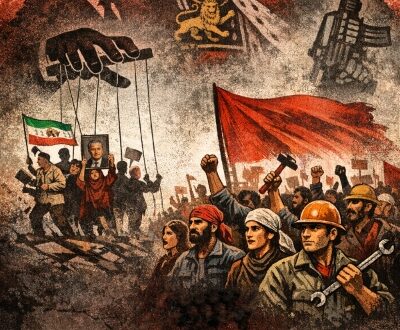
Throughout the entire monstrous existence of the Islamic Republic, class struggle in Iran has never ceased. Workers, toilers, peasants, and strata of the petty bourgeoisie have repeatedly entered into open confrontation with this exploitative and oppressive regime. The continuity, scope, and escalating intensity of these struggles are expressed in mass upsurges in which the oppressed people of Iran have directly attacked the regime’s repressive apparatus and openly raised the slogan of overthrowing the Islamic Republic. The uprisings of January 2018, November 2019, and September 2022—each suppressed only through mass slaughter and nationwide terror—demonstrate both the revolutionary potential of the masses and the counterrevolutionary character of the ruling state.
Today, we are witnessing yet another powerful round of mass popular upsurge in Iran—an organic continuation of this long and bitter history of struggle.
Yet these upsurges are not the sole expression of resistance to the tyrannical regime. Contrary to dominant international narratives, the people of Iran have resisted the Islamic Republic from its very inception. In the earliest days following the seizure of power by Khomeini’s clique, women mobilized against compulsory hijab during the March 8, 1979 International Women’s Day demonstrations.
Shortly after, on March 21, 1979, the regime launched a military assault against the Kurdish people, who had risen in defense of their right to self-determination.
This was followed by the brutal suppression of the Turkmen Sahra movement in February 1980, whose popular councils demanded land and social justice, as well as the crushing of the Arab people’s struggle for self-determination in southern Iran.
Simultaneously, the regime dismantled the workers’ councils that had been formed throughout various sectors of the working class, replacing them with its own yellow councils named “Islamic Labour Councils”, while waging an all-out counter-revolutionary war against communist, revolutionary and democratic organizations nationwide—resulting in mass arrests, systematic torture, and the execution of thousands of militants from 1981 onward, culminating in the 1988 massacre of political prisoners. This atrocity constituted an act of annihilation and genocide against Iran’s communists and revolutionaries.
Furthermore, from the late 1980s through the 1990s, the regime orchestrated a systematic campaign of assassinations against dissident intellectuals and political figures, both inside and outside the country, in what became known as the “Serial Murders of Dissidents.”
And, of course, incessant waves of repression against thousands of worker protests and strikes from the 2000s to the present.
What we witness today, therefore, is not a sudden awakening or a change of heart, but the continuation of decades of popular resistance and revolutionary struggle by the people of Iran.
Support the just struggles of the people of Iran in every possible way.
Down with the Islamic Republic!
Victory to the Revolution!
Long live Socialism!


One Comment
Rachel
The vast majority of people in the West erroneously think of Iran as an independent sovereign nation and have little to no knowledge as to the hows and whys the murderous Islamic regime came to power.
They also mistakenly perceive the Iranian population as having only in recent years begun to demonstrate in droves against their lack of civil rights as well as economic hardships.
This article gives an overview of the actual true origins of this brutal regime contrary to popular belief. It also details the history of the Iranian people’s rejection and uprisings of this imposed dictatorship from its very inception and how the regime in turn mercilessly suppressed them, One can therefore gain a much clearer perspective on the current situation upon its reading regarding the Iranian people’s courageous rage and despair as well as the regime’s ruthless massacres in response.